If any of this sounds familiar, this book was written for you.
- You were told "it's just your age" and sent home with nothing.
- You were refused hormone therapy because of a headline from twenty years ago, and nobody showed you the actual numbers.
- You are waking at 3 a.m. soaked, foggy by noon, and not sure which of it is hormones.
- Your periods have turned unpredictable or heavy, and you don't know what is normal and what needs a call.
- You have read a hundred posts online and trust none of them.
- You get fifteen minutes with your doctor and want to use every one of them well.
The Menopause Atlas doesn't tell you what to take. It tells you what the evidence says, so you can walk in and have the conversation you came for.
Built to be used in the exam room, not admired on the shelf.
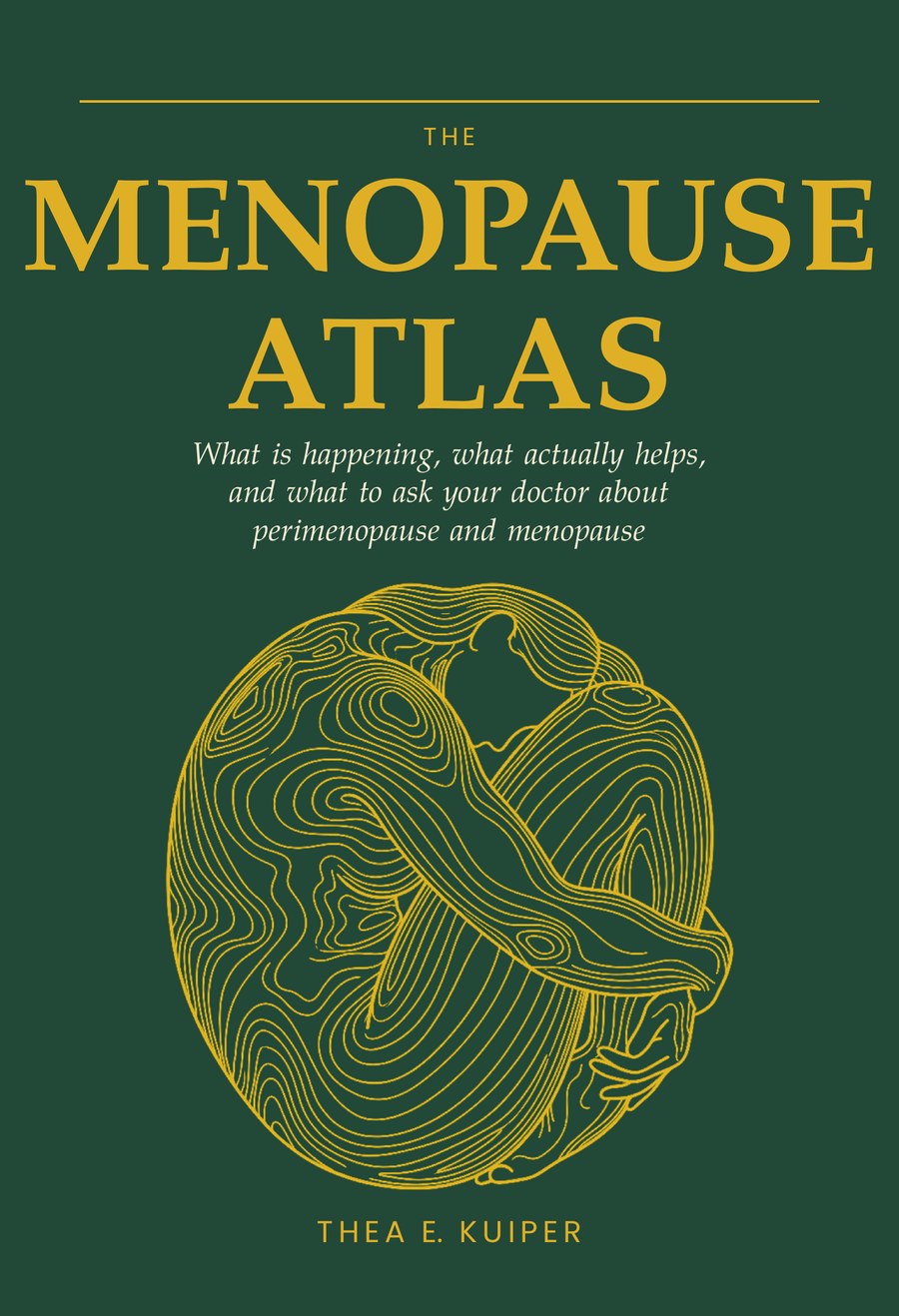
Three rules run through all 424 pages. They are what make this a reference rather than another opinion.
Real numbers, not scary percentages.
A headline says hormone therapy "raises breast cancer risk 26%." This book shows what that means per thousand women over five years, next to the number for women taking nothing, so you can judge the size of the risk for yourself.
Sources in the sentence.
Studies are named where the claim is made, with the journal and the year, and every evidence box says what kind of study it was and where it is weak. When two good studies disagree, you get both and a plain account of why.
It never tells you what to take.
No doses, no regimens. Where a treatment needs a prescription, the book explains what it is for, what the trials found, and what to ask. Nearly every chapter ends with questions for your clinician and the red flags that mean don't wait.
Walk into your next appointment prepared.
Tick what you are dealing with. You'll get a one-page checklist of questions from the book to print or save as a PDF and take with you.
What's going on for you?
Choose as many as apply.
Private by design: nothing you type here is saved or sent anywhere. It stays in this page and disappears when you close it.
My appointment questions
The Menopause AtlasFrom The Menopause Atlas by Thea E. Kuiper · themenopauseatlas.com. Information, not medical advice. These questions are a starting point for a conversation with your clinician.
One sentence that could change your appointment.
From Chapter 19, on hormone therapy. This is what "what to ask your doctor" looks like in practice.
"No hormone therapy" and "no oral hormone therapy" are different answers.
In absolute terms the risk is small. Even at the higher estimates from the Cochrane review, about 99 in 100 women taking oral combined therapy for a year will not have a clot. It is not the coin flip it can sound like.
A Swedish nationwide registry study of over 900,000 women, published in the BMJ in 2024, compared eight hormone therapy routes and regimens. Every oral form raised clot risk. Transdermal forms, tracked as separate groups, did not.
One sentence to bring to your clinician: if you were told you cannot take hormone therapy because of clot risk, ask whether that applies to transdermal estrogen too, or only to the pill. Some clotting conditions carry risk whatever the route, so this is a conversation for your clinician, not a self-diagnosis. Have it anyway.
Thirty-seven chapters. Every one stands on its own.
Each chapter follows the same shape: what you may feel, what is happening in the body, what else it could be, the evidence for each option, the red flags, and the questions to ask. Open it anywhere.
Understanding it
Ch. 1–8
- 1Why This Book Exists, and How to Use It
- 2The Menopause Map: Stages, Timing, and Terminology
- 3What Is Normal, What Is Not: When to Call a Clinician
- 4Hormones 101: Estrogen, Progesterone, Testosterone, FSH
- 5The Brain-Ovary-Body Connection
- 6Why Symptoms Happen: Thermoregulation, Inflammation, Metabolism
- 7Labs, Diagnosis, Tracking, and the Limits of Testing
- 8How to Talk With Your Doctor
The symptoms
Ch. 9–18
- 9Hot Flashes and Night Sweats
- 10Sleep, Insomnia, and Night Waking
- 11Mood, Anxiety, Depression, and Irritability
- 12Brain Fog, Memory, Focus, and Dementia Fears
- 13Period Changes, Heavy Bleeding, and Fibroids
- 14Vaginal Health, GSM, UTIs, and the Pelvic Floor
- 15Sex, Desire, Pain, Intimacy, and Testosterone
- 16Weight, Belly Fat, Blood Sugar, and Metabolism
- 17Joints, Muscles, Pain, and Frozen Shoulder
- 18Skin, Hair, Oral Health, Migraine, and Other Overlooked Symptoms
Treatment
Ch. 19–21
- 19Hormone Therapy: The Decision and the Delivery
- 20HT Risks: Breast, Endometrial, Clot, Stroke, Heart, Dementia
- 21Nonhormonal Prescriptions: SSRIs, SNRIs, Gabapentin, Fezolinetant, Elinzanetant
The long view
Ch. 22–26
- 22Bones and Osteoporosis
- 23Heart, Cholesterol, Blood Pressure, and Metabolic Syndrome
- 24Cancer Risk and Screening
- 25Brain Longevity and Mental Health
- 26Early Menopause, POI, Surgical Menopause, and Cancer Survivors
Food, movement, mind, tradition
Ch. 27–33
- 27The Menopause Plate: What to Eat Now, and What Food Can Actually Do
- 28Movement: Strength, Cardio, Mobility, Pelvic Floor, Recovery
- 29The Stress Reset: Stress Physiology and Nervous System Repair
- 30Mindfulness, CBT, Breathwork, Yoga, and Meditation
- 31Acupuncture and Traditional Chinese Medicine
- 32Ayurveda: Doshas, Heat, Sleep, Digestion, and Midlife Balance
- 33Botanicals and Supplements: What Works, and How to Use Them Safely
Life, and the plan
Ch. 34–37
- 34Relationships, Work, Identity, Aging, Beauty, and Power
- 35Recipes, Menus, Rituals, Shopping Lists, and Kitchen Medicine
- 36The First Thirty Days, and the Ninety After
- 37Resource Guide, Glossary, Trackers, and Evidence Tables
Choose how you want to keep it.
The same 37 chapters in every edition. Only the digital edition is updated when the guidance changes.
- Free corrected editions whenever the guidance changes
- Search every page for the one word you need
- Every "see Chapter 8" is a live link
- Bookmarks for all 37 chapters
- Download link by email within a minute
Secure checkout · 14-day money-back guarantee
- Large format, so tables and figures read at full size
- Room to write in the margins
- Ships from Amazon
- The edition for a shelf you'll keep for twenty years
- A gift that says "I took this seriously"
- Ships from Amazon
The 14-day guarantee. If the digital edition isn't what you hoped, email us within 14 days for a full refund. No questions, and no need to explain.
Buying for your mother, sister, partner, or friend? The paperback and hardcover can ship straight to her as a gift through Amazon. There's also a short section at the back of the book for the people who love her.
Read Chapter 3 free.
Chapter 3 is the one the book tells frightened readers to open first: what is normal, what is not, and when to call. Download it now. No email needed.
- Chapter 3 as a free PDF, 10 pages
- What is normal, what is not, and the red flags that mean call a clinician
One more step: check your inbox and confirm. Then you are in.
One email a month. Never sold or shared. Unsubscribe in one click. Information, not medical advice.
Before you buy.
Is it for perimenopause too, or only after periods stop?
Both. Most symptoms peak during perimenopause, the years before your final period, and the book is organized around that. It also covers early, premature, and surgical menopause, and the long-term health picture after menopause.
Is this medical advice?
No. It is information, designed to help you talk to a clinician rather than replace one. Nothing in it should be used to start, stop, or change a prescription, supplement, or over-the-counter product on your own.
Is it up to date?
It is current to September 2026 and covers two changes that happened while it was being written: the FDA's removal of risk statements from the hormone therapy boxed warning, and ACOG's 2026 update on evaluating postmenopausal bleeding. The digital edition is corrected when guidance changes, and buyers receive each corrected edition free.
How is the digital edition delivered?
By email, within about a minute of purchase, as a download link for a PDF that opens on any phone, tablet, or computer. There is no DRM, so it opens in whatever reader you already use, including the Kindle and Apple Books apps.
Is there a Kindle edition?
Yes, on Amazon. The direct digital edition here is the one that comes with free corrected editions and the searchable, fully linked PDF.
What if it isn't right for me?
Email us within 14 days of buying the digital edition and we'll refund you in full. Print editions are covered by Amazon's return policy.
Does it recommend supplements or alternative medicine?
It assesses them the same way it assesses everything else, and reports null and negative findings as prominently as positive ones. You will not be told to buy anything.
Can I read just the part I need?
That is how it is built. Every chapter defines its own terms, and nearly every one carries its own red-flag box and ends with its own questions. Chapter 3 exists for the reader who opens the book frightened and needs one page.
Your next appointment can go differently.
Go in knowing what the evidence says, what your options are, and exactly what to ask.